Tourist City Niseko and two ride events (2)
Niseko Classic, Japan’s only certified qualifier for the UCI Gran Fondo World Championships

Now, one of the fun parts of a fun ride is the refreshments at the aid stations. AEON Hokkaido was a special sponsor of this event, and a large amount of AEON PB jellies, drinks, bananas, and other items were distributed to support the participants’ run.

*This article is a reprint of a July 2019 article.

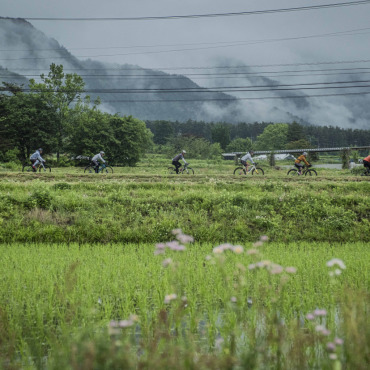
There are always sentinel staff stationed at points where turns are to be made on the course, as well as accompanying staff to deal with mechanical problems, and other support systems are in place so that participants can concentrate only on running. Incidentally, Mt. Yotei, which is rarely seen at this time of year, made an appearance, and together with the vast landscape typical of Hokkaido, the trip was a very memorable experience.

In addition, original T-shirts were given out as participation prizes, and at the post-goal event, various outdoor brand items handled by the sponsor, Ikeuchi Group, were offered as raffle prizes. In addition, images taken along the way will be freely downloadable, a nice perk for today’s social networking-loving cyclists.

Next, I would like to talk about the Niseko Classic. This citizens’ race, modeled after the Tour de Okinawa held every November in Okinawa Prefecture, started out as a hill climb race and has grown into a full-scale road race held on closed public roads over the past six years. This year marks the fourth season that the event has been included in the qualifying round of the UCI Gran Fondo World Championships (hereinafter referred to as the UCIGFWS). This qualifying competition will be held in 21 locations around the world for the 2019 season, with only Niseko and India being held here in Asia. Competitors placing in the top 25% in each category will be eligible to participate in the finals (Poznan, Poland in 2019).

Therefore, there were many entrants from overseas who wanted to advance to the finals, and of the 1,200 entrants in the road race category, a whopping 20% were foreigners this year. After Singapore and Taiwan, the number of participants from Australia, perhaps due to the location of Niseko, as explained at the beginning of this report.


EVENT
The Japanese Odyssey Report Season 2
A Crazy Journey Returns: Setting Sail for the 2025 #06
The 300km/day Speedster Engineer 🇬🇧
The Ascetic Bike Addict (Co-Organizer #2) 🇫🇷
The “Harukist” Route Maker (Co-Organizer #1) 🇫🇷

The second installment of The Japanese Odyssey (TJO), scheduled for autumn 2025, dives into the riding philosophies and gear preferences of the fastest rider from the 2016 event and the two organizers from France. If you’re intrigued by the challenge of ultra-long-distance cycling, this is a must-read! Take inspiration from their bikepacking setups and consider joining the adventure yourself. For detailed schedules and routes for this year, please visit the official website (as of January 2025, these are yet to be announced). *You can find the previous essay here. The 300km/day Speedster Engineer / TOM WILLARD(England) Before the start, he was the first to arrive at Nihonbashi ear […]

EVENT
What is the Rumored Japanese Odyssey? #04
A crazy setup.

Table of Contents 1. Checkpoints and Segments2. The “Subtlety” of the Route 1. Checkpoints and Segments The 2016 event begins at Nihonbashi in Tokyo and passes through 11 mountain checkpoints (CP) scattered across various regions of Japan. Riders aim to reach the final destination, Dotonbori in Osaka, within two weeks. The total distance is approximately 2,500 to 3,000 km. The level of craziness has certainly increased compared to the previous year. Nihonbashi to Dotonbori—usually a familiar route along the Tokaido, should only be about 550 km using Route 1. So, how does it become 3,000 km? The key to this puzzle lies in the checkpoints. Here are the CPs that were required for co […]

What is the Rumored Japanese Odyssey?#06
“Japan favoritism” or “Bias towards Japan”

Table of Contents 1 Haruki Murakami, Basho2 The Romantics 1. Haruki Murakami, Basho It is well known that the French have a fondness for Japan, and although Emmanuel and Guillaume (the organizers of The Japanese Odyssey) initially seemed to have no direct connection to the country, they were, in fact, deeply captivated by Japanese culture. What especially drew them in were the works of Haruki Murakami, which are highly popular in Europe, and the haiku of Basho—examples of Japan’s lyrical literary tradition. After the 2016 race, when I interviewed them for the first time, I was struck by their enthusiasm, which could not be explained by mere tourism or exoticism. If the emotional depth of lit […]